Character-level tokenizer. More...
Public Member Functions | |
| CharTokenizer (CharVocabulary vocab) | |
| Construct a CharTokenizer with a vocabulary. | |
| std::string | decode (std::span< const TokenId > tokens) override |
| Decode token ids back to text. | |
| std::vector< TokenId > | encode (const std::string &text) override |
| Encode text into token ids (one id per input byte). | |
| std::optional< TokenId > | getBosTokenId () const override |
| BOS id query - not supported for char-level tokenizer. | |
| std::optional< TokenId > | getEosTokenId () const override |
| EOS id query - not supported for char-level tokenizer. | |
| std::optional< TokenId > | getPadTokenId () const override |
| PAD id query - not supported for char-level tokenizer. | |
| size_t | getVocabSize () const override |
| Number of tokens in the underlying vocabulary. | |
| bool | isValidToken (TokenId tokenId) const override |
| Check if token id is valid in the vocabulary. | |
| std::string | tokenToString (TokenId tokenId) const override |
| Convert a token id to a debug string. | |
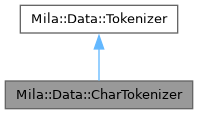
| Public Member Functions inherited from Mila::Data::Tokenizer | |
| virtual | ~Tokenizer ()=default |
Static Public Member Functions | |
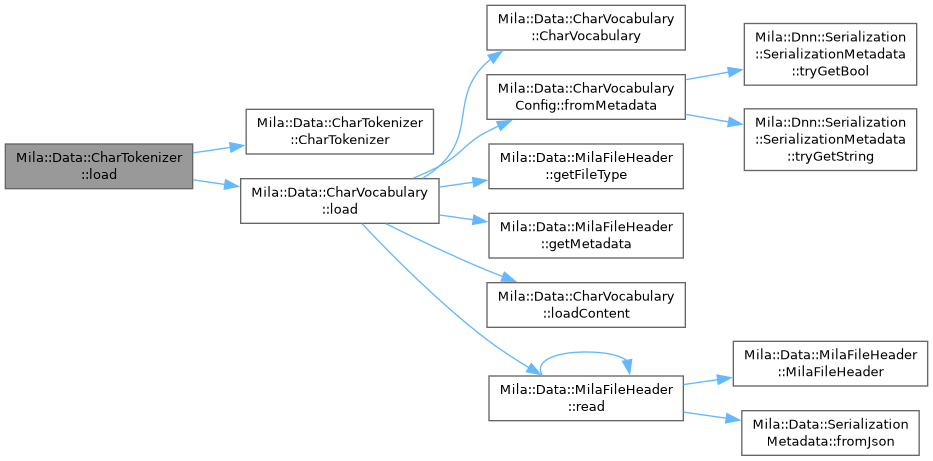
| static CharTokenizer | load (const std::filesystem::path &path) |
Private Attributes | |
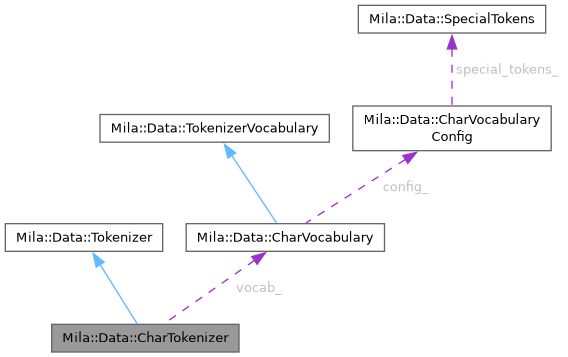
| CharVocabulary | vocab_ |
Detailed Description
Character-level tokenizer.
This tokenizer treats tokens as single bytes (single-character strings). It delegates all token <-> id mapping and persistence to a TokenizerVocabulary implementation.
Ownership:
- The tokenizer holds a shared pointer to the vocabulary so the same vocabulary instance may be shared between tokenizers or other users.
Encoding/decoding semantics:
- encode() produces a TokenId for each byte in the input string. If a token is not found in the vocabulary the encoder emits 0u as a fallback id.
- decode() converts each TokenId back to the first byte of the token string returned by the vocabulary; missing ids produce a '?' character.
Note: This implementation does not add or interpret BOS/EOS tokens; encodeWithSpecial() ignores the addBos/addEos flags because the generic TokenizerVocabulary interface does not expose special-token ids.
Constructor & Destructor Documentation
◆ CharTokenizer()
|
inlineexplicit |
Construct a CharTokenizer with a vocabulary.
- Parameters
-
vocab Shared pointer to a TokenizerVocabulary implementation. Must remain valid for the lifetime of this tokenizer.

Member Function Documentation
◆ decode()
|
inlineoverridevirtual |
Decode token ids back to text.
Each token id is converted to its token string via the vocabulary, and the first byte of that token is appended to the result. If an id is missing the character '?' is appended.
- Parameters
-
tokens Span of token ids to decode.
- Returns
- Decoded text string.
Implements Mila::Data::Tokenizer.
◆ encode()
|
inlineoverridevirtual |
Encode text into token ids (one id per input byte).
- Parameters
-
text UTF-8 encoded text to encode. Each input byte is treated as a separate token; callers should handle multi-byte characters if needed.
- Returns
- std::vector<TokenId> Vector of token ids; missing tokens map to 0u.
Implements Mila::Data::Tokenizer.
◆ getBosTokenId()
|
inlineoverridevirtual |
BOS id query - not supported for char-level tokenizer.
Returns empty optional because the generic vocabulary does not expose special-token ids in the interface.
Implements Mila::Data::Tokenizer.
◆ getEosTokenId()
|
inlineoverridevirtual |
EOS id query - not supported for char-level tokenizer.
Implements Mila::Data::Tokenizer.
◆ getPadTokenId()
|
inlineoverridevirtual |
PAD id query - not supported for char-level tokenizer.
Implements Mila::Data::Tokenizer.
◆ getVocabSize()
|
inlineoverridevirtual |
Number of tokens in the underlying vocabulary.
Implements Mila::Data::Tokenizer.
◆ isValidToken()
|
inlineoverridevirtual |
Check if token id is valid in the vocabulary.
Implements Mila::Data::Tokenizer.
◆ load()
|
inlinestatic |
◆ tokenToString()
|
inlineoverridevirtual |
Convert a token id to a debug string.
Returns the token string from the vocabulary or an empty string if not found.
Implements Mila::Data::Tokenizer.
Member Data Documentation
◆ vocab_
|
private |
The documentation for this class was generated from the following file:
- /__w/Mila/Mila/Mila/Src/Data/Tokenizers/Char/CharTokenizer.ixx