Configuration for Character-level tokenizer training. More...
Public Member Functions | |
| CharVocabularyConfig ()=default | |
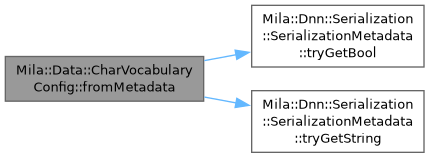
| void | fromMetadata (const SerializationMetadata &meta) |
| Populate configuration from metadata. | |
| const SpecialTokens & | getSpecialTokens () const |
| bool | isByteLevel () const |
| bool | isCaseSensitive () const |
| bool | shouldNormalizeUnicode () const |
| SerializationMetadata | toMetadata () const |
| Convert configuration to metadata for serialization. | |
| std::string | toString () const |
| Produce human-readable summary of configuration. | |
| void | validate () const |
| Validate configuration parameters. | |
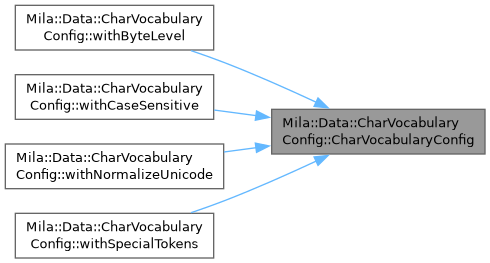
| CharVocabularyConfig & | withByteLevel (bool byte_level) |
| Set whether to use byte-level encoding. | |
| CharVocabularyConfig & | withCaseSensitive (bool sensitive) |
| Set whether tokenization is case-sensitive. | |
| CharVocabularyConfig & | withNormalizeUnicode (bool normalize) |
| Set whether to normalize Unicode characters. | |
| CharVocabularyConfig & | withSpecialTokens (const SpecialTokens &tokens) |
| Configure special tokens. | |
Private Attributes | |
| bool | byte_level_ = false |
| bool | case_sensitive_ = true |
| bool | normalize_unicode_ = false |
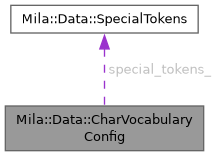
| SpecialTokens | special_tokens_ {} |
Detailed Description
Configuration for Character-level tokenizer training.
Character tokenizers split text into individual characters (or bytes). This is the simplest tokenization approach with minimal configuration needs.
Fluent interface allows chaining:
Constructor & Destructor Documentation
◆ CharVocabularyConfig()
|
default |
Member Function Documentation
◆ fromMetadata()
|
inline |
Populate configuration from metadata.
Missing keys are ignored leaving defaults intact.
- Parameters
-
meta Metadata to read configuration from.

◆ getSpecialTokens()
|
inline |
◆ isByteLevel()
|
inline |
◆ isCaseSensitive()
|
inline |
◆ shouldNormalizeUnicode()
|
inline |
◆ toMetadata()
|
inline |
Convert configuration to metadata for serialization.
- Returns
- SerializationMetadata containing all configuration parameters.

◆ toString()
|
inline |
Produce human-readable summary of configuration.
Suitable for logging and debugging.
- Returns
- std::string Configuration summary.
◆ validate()
|
inline |
Validate configuration parameters.
- Exceptions
-
std::invalid_argument if configuration is invalid.

◆ withByteLevel()
|
inline |
Set whether to use byte-level encoding.
When true, operates on raw UTF-8 bytes instead of Unicode characters. This guarantees any text can be represented but increases sequence length.
- Parameters
-
byte_level True for byte-level, false for character-level (default).
- Returns
- Reference to this config for method chaining.

◆ withCaseSensitive()
|
inline |
Set whether tokenization is case-sensitive.
When false, text is converted to lowercase before tokenization. This reduces vocabulary size but loses case information.
- Parameters
-
sensitive True for case-sensitive (default), false for case-insensitive.
- Returns
- Reference to this config for method chaining.

◆ withNormalizeUnicode()
|
inline |
Set whether to normalize Unicode characters.
When true, applies Unicode normalization (e.g., NFC) to ensure consistent representation of characters with multiple encodings.
- Parameters
-
normalize True to normalize Unicode, false otherwise (default).
- Returns
- Reference to this config for method chaining.

◆ withSpecialTokens()
|
inline |
Configure special tokens.
- Parameters
-
tokens SpecialTokens configuration.
- Returns
- Reference to this config for method chaining.

Member Data Documentation
◆ byte_level_
|
private |
◆ case_sensitive_
|
private |
◆ normalize_unicode_
|
private |
◆ special_tokens_
|
private |
The documentation for this class was generated from the following file:
- /__w/Mila/Mila/Mila/Src/Data/Tokenizers/Char/CharVocabularyConfig.ixx