Device-agnostic data loader interface using abstract tensor data types. More...
Public Types | |
| using | InputDataType = TensorDataType |
| Input tensor abstract data type. | |
| using | InputTensor = Tensor<TInputDataType, TMemoryResource> |
| Input tensor type alias. | |
| using | MemoryResource = TMemoryResource |
| Memory resource type for tensor allocation. | |
| using | TargetDataType = TensorDataType |
| Target tensor abstract data type. | |
| using | TargetTensor = Tensor<TTargetDataType, TMemoryResource> |
| Target tensor type alias. | |
Public Member Functions | |
| DataLoader (const DataLoader &)=delete | |
| Copy operations explicitly deleted for performance safety. | |
| DataLoader (DataLoader &&)=default | |
| Move operations for efficient ownership transfer. | |
| DataLoader (int64_t batch_size) | |
| Constructs data loader with specified batch configuration. | |
| virtual | ~DataLoader ()=default |
| Virtual destructor ensuring proper cleanup in derived classes. | |
| int64_t | batchSize () const noexcept |
| Returns the configured batch size. | |
| int64_t | currentBatch () const noexcept |
| Returns the current batch index. | |
| virtual std::string | getDatasetInfo () const |
| Returns dataset statistics for optimization and analysis. | |
| virtual bool | hasNext () const |
| Checks if more batches are available. | |
| virtual const InputTensor & | inputs () const =0 |
| Provides immutable access to input tensor for current batch. | |
| virtual InputTensor & | inputs ()=0 |
| Provides mutable access to input tensor for current batch. | |
| virtual void | nextBatch ()=0 |
| Loads the next batch of data from the dataset. | |
| virtual int64_t | numBatches () const =0 |
| Returns the total number of batches in the dataset. | |
| DataLoader & | operator= (const DataLoader &)=delete |
| DataLoader & | operator= (DataLoader &&)=default |
| virtual void | reset () |
| Resets the loader to the beginning of the dataset. | |
| virtual const TargetTensor & | targets () const =0 |
| Provides immutable access to target tensor for current batch. | |
| virtual TargetTensor & | targets ()=0 |
| Provides mutable access to target tensor for current batch. | |
| virtual bool | validateCurrentBatch () const |
| Validates current batch data integrity. | |
Static Public Member Functions | |
| static constexpr bool | supportsMixedPrecision () noexcept |
| Checks if data loader supports mixed-precision workflows. | |
| static constexpr bool | usesPinnedMemory () noexcept |
| Checks if data loader uses pinned memory for GPU optimization. | |
Static Public Attributes | |
| static constexpr TensorDataType | input_data_type = TInputDataType |
| Compile-time input data type constant. | |
| static constexpr bool | is_mixed_precision = (TInputDataType != TTargetDataType) |
| Mixed-precision workflow detection. | |
| static constexpr TensorDataType | target_data_type = TTargetDataType |
| Compile-time target data type constant. | |
| static constexpr bool | uses_pinned_memory = false |
| Pinned memory optimization (CUDA-only; false on CPU-only builds). | |
Protected Member Functions | |
| void | incrementBatch () noexcept |
| Increments current batch counter. | |
| void | setCurrentBatch (int64_t batch_index) noexcept |
| Updates current batch counter. | |
Private Attributes | |
| int64_t | batch_size_ |
| Number of samples in each batch (immutable after construction). | |
| int64_t | current_batch_ |
| Zero-based index of currently loaded batch. | |
Detailed Description
class Mila::Data::DataLoader< TInputDataType, TTargetDataType, TMemoryResource >
Device-agnostic data loader interface using abstract tensor data types.
Advanced data loading framework providing efficient batch processing for neural network training and evaluation across heterogeneous compute environments. Uses abstract TensorDataType enumeration to enable seamless operation on different devices without exposing device-specific concrete types to host compilation.
Core architectural principles:
- Abstract data types prevent device-specific compilation issues
- Support for mixed-precision workflows with different input/target types
- Optimized memory resource selection for efficient data pipeline performance
- Type-safe operations with compile-time compatibility validation
- Extensible design supporting various data sources and preprocessing pipelines
The loader supports both CPU and pinned memory resources for optimal performance in GPU training scenarios, enabling efficient overlapped data transfers while maintaining device independence through the abstract type system.
- Template Parameters
-
TInputDataType Abstract data type for input tensors from TensorDataType enumeration TTargetDataType Abstract data type for target tensors from TensorDataType enumeration TMemoryResource Memory resource type determining allocation strategy and device targeting
- Note
- Memory resource must be either CudaPinnedMemoryResource or CpuMemoryResource for host accessibility
- Input and target data types must be compatible with the specified memory resource
- Derived classes must implement pure virtual methods for specific data source integration
- See also
- TensorDataType for supported abstract data type enumeration
- TensorDataTypeTraits for compile-time data type characteristics
- MemoryResource for device memory abstraction layer
Example usage:
Member Typedef Documentation
◆ InputDataType
| using Mila::Data::DataLoader< TInputDataType, TTargetDataType, TMemoryResource >::InputDataType = TensorDataType |
Input tensor abstract data type.
◆ InputTensor
| using Mila::Data::DataLoader< TInputDataType, TTargetDataType, TMemoryResource >::InputTensor = Tensor<TInputDataType, TMemoryResource> |
Input tensor type alias.
◆ MemoryResource
| using Mila::Data::DataLoader< TInputDataType, TTargetDataType, TMemoryResource >::MemoryResource = TMemoryResource |
Memory resource type for tensor allocation.
◆ TargetDataType
| using Mila::Data::DataLoader< TInputDataType, TTargetDataType, TMemoryResource >::TargetDataType = TensorDataType |
Target tensor abstract data type.
◆ TargetTensor
| using Mila::Data::DataLoader< TInputDataType, TTargetDataType, TMemoryResource >::TargetTensor = Tensor<TTargetDataType, TMemoryResource> |
Target tensor type alias.
Constructor & Destructor Documentation
◆ DataLoader() [1/3]
|
inlineexplicit |
Constructs data loader with specified batch configuration.
Initializes the data loader with the specified batch size and prepares the internal state for efficient batch processing. The loader is ready to begin data iteration after construction.
- Parameters
-
batch_size Number of samples to include in each batch
- Exceptions
-
std::invalid_argument If batch_size is zero
- Note
- Batch size affects memory allocation and processing efficiency
- Larger batches generally improve throughput but require more memory
- Consider GPU memory constraints when selecting batch size for device training
◆ ~DataLoader()
|
virtualdefault |
Virtual destructor ensuring proper cleanup in derived classes.
Provides proper resource cleanup for polymorphic destruction, enabling safe use of base class pointers to derived instances.
◆ DataLoader() [2/3]
|
delete |
Copy operations explicitly deleted for performance safety.
Prevents accidental expensive copy operations involving large datasets and complex internal state management.
◆ DataLoader() [3/3]
|
default |
Move operations for efficient ownership transfer.
Enables efficient transfer of data loader instances without copying internal state or dataset references.
Member Function Documentation
◆ batchSize()
|
inlinenoexcept |
Returns the configured batch size.
Provides the number of samples included in each batch as specified during data loader construction. This value remains constant throughout the loader's lifetime.
- Returns
- Number of samples in each batch
- Note
- Final batch may contain fewer samples if dataset size is not divisible by batch size
- Batch size affects memory requirements and processing efficiency
◆ currentBatch()
|
inlinenoexcept |
Returns the current batch index.
Provides the zero-based index of the batch that was most recently loaded through nextBatch(). Useful for progress tracking and debugging data loading workflows.
- Returns
- Zero-based index of current batch
- Note
- Returns 0 before first call to nextBatch()
- Index increments with each successful nextBatch() call
- Reset to 0 when reset() method is called
◆ getDatasetInfo()
|
inlinevirtual |
Returns dataset statistics for optimization and analysis.
Derived classes may override this method to provide dataset-specific statistics such as sample count, class distribution, or data characteristics that can inform training optimization and analysis.
- Returns
- String containing human-readable dataset statistics
- Note
- Default implementation provides basic batch configuration information
- Override to include dataset-specific metrics and characteristics
◆ hasNext()
|
inlinevirtual |
Checks if more batches are available.
Determines whether additional batches can be loaded from the dataset, enabling efficient iteration control in training and evaluation loops.
- Returns
- true if more batches are available, false if dataset is exhausted
- Note
- Implementation should consider current position and total dataset size
- Used to determine when to reset or stop iteration
◆ incrementBatch()
|
inlineprotectednoexcept |
Increments current batch counter.
Protected helper method for derived classes to increment the batch counter after successfully loading the next batch. Simplifies sequential batch loading implementations.
- Note
- Should be called by derived classes after successful nextBatch() operation
- Automatically handles sequential batch progression
◆ inputs() [1/2]
|
pure virtual |
Provides immutable access to input tensor for current batch.
Derived classes must implement this method to provide read-only access to the tensor containing input data for the currently loaded batch.
- Returns
- Const reference to input tensor containing current batch data
- Note
- Enables safe access for analysis and debugging without modification risk
- Should return same data as mutable version
Implemented in Mila::Data::TokenSequenceLoader< TMemoryResource >.
◆ inputs() [2/2]
|
pure virtual |
Provides mutable access to input tensor for current batch.
Derived classes must implement this method to provide access to the tensor containing input data for the currently loaded batch. The tensor should be properly shaped and contain valid data after nextBatch() call.
- Returns
- Mutable reference to input tensor containing current batch data
- Note
- Tensor shape should match expected input dimensions for the model
- Data should be preprocessed and ready for model consumption
- Memory layout should be optimized for target compute device
Implemented in Mila::Data::TokenSequenceLoader< TMemoryResource >.

◆ nextBatch()
|
pure virtual |
Loads the next batch of data from the dataset.
Derived classes must implement this method to load the next batch of data into the input and target tensors. Implementation should handle data preprocessing, memory allocation, and batch composition according to the specific dataset requirements.
- Exceptions
-
std::runtime_error If no more batches are available std::runtime_error If data loading fails
- Note
- Implementation must update current_batch_ counter after successful load
- Should handle end-of-dataset conditions appropriately
- May involve complex preprocessing pipelines and data augmentation
Implemented in Mila::Data::TokenSequenceLoader< TMemoryResource >.
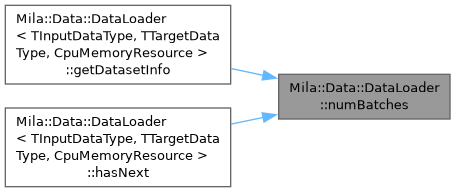
◆ numBatches()
|
pure virtual |
Returns the total number of batches in the dataset.
Derived classes must implement this method to report the total number of batches available in their specific dataset. This information is essential for training loop progress tracking and epoch management.
- Returns
- Total number of batches available in the dataset
- Note
- Implementation should account for partial batches at dataset end
- Value may change if dataset is modified or resampled
- Used for training progress reporting and epoch boundary detection
Implemented in Mila::Data::TokenSequenceLoader< TMemoryResource >.
◆ operator=() [1/2]
|
delete |
◆ operator=() [2/2]
|
default |
◆ reset()
|
inlinevirtual |
Resets the loader to the beginning of the dataset.
Resets the internal state to start iteration from the first batch. Derived classes may override this method to implement additional reset functionality such as dataset reshuffling or preprocessing pipeline reinitialization.
- Note
- Base implementation resets batch counter to zero
- Called automatically at epoch boundaries in training loops
- Override to implement custom reset behavior (shuffling, etc.)
Reimplemented in Mila::Data::TokenSequenceLoader< TMemoryResource >.
◆ setCurrentBatch()
|
inlineprotectednoexcept |
Updates current batch counter.
Protected helper method for derived classes to update the batch counter after successfully loading a new batch. Ensures consistent state management across all data loader implementations.
- Parameters
-
batch_index New batch index to set
- Note
- Should be called by derived classes after successful batch loading
- Enables consistent progress tracking across all loader types
◆ supportsMixedPrecision()
|
inlinestaticconstexprnoexcept |
Checks if data loader supports mixed-precision workflows.
Compile-time detection of whether the loader uses different data types for inputs and targets, enabling mixed-precision training optimizations.
- Returns
- true if input and target use different data types, false otherwise
◆ targets() [1/2]
|
pure virtual |
Provides immutable access to target tensor for current batch.
Derived classes must implement this method to provide read-only access to the tensor containing target/label data for the currently loaded batch.
- Returns
- Const reference to target tensor containing current batch labels
- Note
- Enables safe access for analysis and debugging without modification risk
- Should return same data as mutable version
Implemented in Mila::Data::TokenSequenceLoader< TMemoryResource >.
◆ targets() [2/2]
|
pure virtual |
Provides mutable access to target tensor for current batch.
Derived classes must implement this method to provide access to the tensor containing target/label data for the currently loaded batch. The tensor should contain ground truth data corresponding to the inputs.
- Returns
- Mutable reference to target tensor containing current batch labels
- Note
- Target data should align with input batch ordering
- Data format should match model's expected output structure
- For mixed-precision workflows, may use different data type than inputs
Implemented in Mila::Data::TokenSequenceLoader< TMemoryResource >.

◆ usesPinnedMemory()
|
inlinestaticconstexprnoexcept |
Checks if data loader uses pinned memory for GPU optimization.
Compile-time detection of pinned memory usage, indicating optimization for efficient host-to-device memory transfers in GPU training scenarios.
- Returns
- true if using pinned memory, false for standard CPU memory
◆ validateCurrentBatch()
|
inlinevirtual |
Validates current batch data integrity.
Derived classes may override this method to implement data validation checks ensuring batch integrity, proper tensor shapes, and valid data ranges. Useful for debugging data loading pipelines and preprocessing issues.
- Returns
- true if current batch data passes validation, false otherwise
- Note
- Default implementation performs basic existence checks
- Override to implement dataset-specific validation logic
- Can be used in debug builds for comprehensive data verification
Member Data Documentation
◆ batch_size_
|
private |
Number of samples in each batch (immutable after construction).
◆ current_batch_
|
private |
Zero-based index of currently loaded batch.
◆ input_data_type
|
staticconstexpr |
Compile-time input data type constant.
◆ is_mixed_precision
|
staticconstexpr |
Mixed-precision workflow detection.
◆ target_data_type
|
staticconstexpr |
Compile-time target data type constant.
◆ uses_pinned_memory
|
staticconstexpr |
Pinned memory optimization (CUDA-only; false on CPU-only builds).
The documentation for this class was generated from the following file:
- /__w/Mila/Mila/Mila/Src/Data/Loaders/DataLoader.ixx