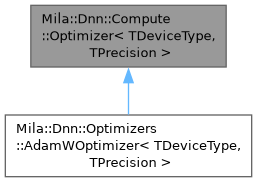
Abstract base class for parameter optimizers. More...
Public Member Functions | |
| virtual | ~Optimizer ()=default |
| virtual void | addParameter (ITensor *param, ITensor *grad)=0 |
| Register a parameter tensor for optimization. | |
| virtual float | getLearningRate () const =0 |
| Get the current learning rate. | |
| virtual void | setLearningRate (float learning_rate)=0 |
| Set the learning rate for future updates. | |
| virtual void | step ()=0 |
| Perform one optimization step. | |
Detailed Description
class Mila::Dnn::Compute::Optimizer< TDeviceType, TPrecision >
Abstract base class for parameter optimizers.
Optimizers update model parameters using computed gradients according to specific update rules (SGD, Adam, AdamW, etc.). The optimizer:
- Maintains internal state per parameter (momentum, velocity, etc.)
- Performs parameter updates via step()
Template Parameters:
- Template Parameters
-
TDeviceType Device where optimization occurs (DeviceType::Cpu or DeviceType::Cuda) TPrecision Abstract tensor precision (TensorDataType::FP32, FP16, BF16)
Typical usage pattern:
Implementation Requirements:
- Derived classes must handle device-specific memory and execution
- State tensors (momentum, variance) must reside on same device as parameters
- Thread-safety is not guaranteed; synchronize externally if needed
- Parameters must remain valid for optimizer lifetime
- Note
- Parameters and gradients are stored as weak references; the Module retains ownership and is responsible for parameter lifetime.
- Implementations should support asynchronous execution where possible (e.g., CUDA streams) without requiring explicit synchronization in step().
Constructor & Destructor Documentation
◆ ~Optimizer()
|
virtualdefault |
Member Function Documentation
◆ addParameter()
|
pure virtual |
Register a parameter tensor for optimization.
Adds a parameter-gradient pair to the optimizer's update list. The optimizer will allocate internal state tensors (momentum, variance, etc.) matching the parameter shape and device placement.
- Parameters
-
param Shared pointer to parameter tensor to be optimized grad Shared pointer to gradient tensor (must match param shape)
- Exceptions
-
std::invalid_argument if param or grad is nullptr std::invalid_argument if param and grad shapes don't match std::invalid_argument if param and grad are on different devices std::runtime_error if state allocation fails
- Note
- Must be called after model->build() when parameter shapes are known
- Parameter and gradient must persist for the optimizer's lifetime
- Calling multiple times with same parameter updates the gradient reference
- State tensors are initialized to zero on first registration
- See also
- step()
Example:
Implemented in Mila::Dnn::Compute::CpuAdamWOptimizer< TPrecision >, Mila::Dnn::Compute::CudaAdamWOptimizer< TPrecision >, and Mila::Dnn::Optimizers::AdamWOptimizer< TDeviceType, TPrecision >.
◆ getLearningRate()
|
pure virtual |
Get the current learning rate.
Returns the base learning rate used for parameter updates. Some optimizers may apply adaptive per-parameter learning rates internally (Adam, AdamW), but this method returns the global scaling factor.
- Returns
- Current learning rate as a float
- Note
- For adaptive optimizers, actual effective learning rate per parameter may differ due to momentum and variance scaling
- See also
- setLearningRate()
Implemented in Mila::Dnn::Compute::CpuAdamWOptimizer< TPrecision >, Mila::Dnn::Compute::CudaAdamWOptimizer< TPrecision >, and Mila::Dnn::Optimizers::AdamWOptimizer< TDeviceType, TPrecision >.
◆ setLearningRate()
|
pure virtual |
Set the learning rate for future updates.
Updates the base learning rate used by the optimizer. Typically used for learning rate schedules (decay, warmup, cyclic, etc.).
- Parameters
-
learning_rate New learning rate (must be positive)
- Exceptions
-
std::invalid_argument if learning_rate <= 0
- Note
- Takes effect immediately for the next step() call
- Does not affect optimizer state (momentum, variance)
- For learning rate schedules, call this at epoch or iteration boundaries
- See also
- getLearningRate()
Example with learning rate decay:
Implemented in Mila::Dnn::Compute::CpuAdamWOptimizer< TPrecision >, Mila::Dnn::Compute::CudaAdamWOptimizer< TPrecision >, and Mila::Dnn::Optimizers::AdamWOptimizer< TDeviceType, TPrecision >.
◆ step()
|
pure virtual |
Perform one optimization step.
Updates all registered parameters using their accumulated gradients according to the optimizer's update rule (SGD, Adam, AdamW, etc.). This is the HOT PATH method called every training iteration.
For algorithms with state (Adam, AdamW):
- Updates first and second moment estimates
- Applies bias correction if needed
- Computes parameter update
- Writes updated parameters back to tensors
- Exceptions
-
std::runtime_error if no parameters have been registered std::runtime_error if gradient data is invalid or null
- Note
- Gradients should be computed via backward() before calling step()
- For CUDA implementations, may be asynchronous (uses device stream)
- Increments internal step counter for algorithms requiring it (Adam, AdamW)
- See also
- addParameter()
- backward()
Typical sequence:
Implemented in Mila::Dnn::Compute::CpuAdamWOptimizer< TPrecision >, Mila::Dnn::Compute::CudaAdamWOptimizer< TPrecision >, and Mila::Dnn::Optimizers::AdamWOptimizer< TDeviceType, TPrecision >.
The documentation for this class was generated from the following file:
- /__w/Mila/Mila/Mila/Src/Dnn/Compute/Optimizers/OptimizerBase.ixx