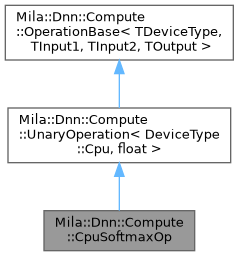
CPU implementation of Softmax using abstract TensorDataType API. More...

Public Types | |
| using | CpuExecutionContext = ExecutionContext<DeviceType::Cpu> |
| using | MR = CpuMemoryResource |
| using | TensorType = Tensor<TensorDataType::FP32, MR> |
| using | UnaryOperationBase = UnaryOperation<DeviceType::Cpu, TensorDataType::FP32> |
| Public Types inherited from Mila::Dnn::Compute::UnaryOperation< DeviceType::Cpu, TensorDataType::FP32 > | |
| using | MR |
| using | TensorInputType |
| using | TensorOutputType |
| Public Types inherited from Mila::Dnn::Compute::Operation< TDeviceType, TInput > | |
| using | DataTypeTraits |
Public Member Functions | |
| CpuSoftmaxOp (IExecutionContext *context, const SoftmaxConfig &config) | |
| void | backward (const ITensor &input, const ITensor &output_grad, ITensor &input_grad) const override |
| Backward pass - HOT PATH, pure dispatch to CPU kernel. | |
| void | build (const BuildContext &config) override |
| Build the operation for a concrete input shape. | |
| void | forward (const ITensor &input, ITensor &output) const override |
| Forward pass - HOT PATH, pure dispatch to CPU kernel. | |
| const SoftmaxConfig & | getConfig () const |
| std::string | getName () const override |
| Human-readable operation name. | |
| OperationType | getOperationType () const override |
| Operation type identifier. | |
| void | setParameters (ITensor *weight, ITensor *bias) override |
| Set parameter tensor references (no-op for Softmax - stateless operation). | |
| Public Member Functions inherited from Mila::Dnn::Compute::UnaryOperation< DeviceType::Cpu, TensorDataType::FP32 > | |
| virtual | ~UnaryOperation ()=default |
| Public Member Functions inherited from Mila::Dnn::Compute::Operation< TDeviceType, TInput > | |
| virtual | ~Operation ()=default |
| virtual void | clearGradients () noexcept |
| Clear any cached gradient pointers held by the operation. | |
| virtual TensorDataType | getDataType () const |
| Tensor data type for this operation. | |
| virtual DeviceType | getDeviceType () const |
| Device type for this operation. | |
| virtual std::size_t | getStateMemorySize () const |
| Returns the number of bytes of state memory allocated by this operation. | |
| virtual bool | isBuilt () const |
| Whether build() completed successfully for a concrete input shape. | |
| virtual bool | isEvalMode () const |
| Query whether operation is configured for training. | |
| virtual void | setGradients (ITensor *weight_grad, ITensor *bias_grad) |
| Bind module-owned gradient tensors to the operation. | |
| virtual void | setTrainingMode (TrainingMode training_mode) |
| Configure operation training-mode behavior. | |
Private Attributes | |
| int64_t | cached_axis_ { -1 } |
| int64_t | cached_dim_size_ { 0 } |
| int64_t | cached_inner_size_ { 0 } |
| int64_t | cached_outer_size_ { 0 } |
| SoftmaxConfig | config_ |
| IExecutionContext * | context_ |
| bool | enable_omp_ { false } |
Additional Inherited Members | |
| Static Public Attributes inherited from Mila::Dnn::Compute::Operation< TDeviceType, TInput > | |
| static constexpr TensorDataType | data_type |
| static constexpr DeviceType | device_type |
| Static Protected Member Functions inherited from Mila::Dnn::Compute::UnaryOperation< DeviceType::Cpu, TensorDataType::FP32 > | |
| static const TensorInputType & | asInputTensor (const ITensor &t) |
| static TensorOutputType & | asOutputTensor (ITensor &t) |
| Protected Attributes inherited from Mila::Dnn::Compute::Operation< TDeviceType, TInput > | |
| bool | is_built_ |
| TrainingMode | training_mode_ |
Detailed Description
CPU implementation of Softmax using abstract TensorDataType API.
Template parameter TPrecision selects the abstract tensor precision (e.g. FP32). float is the corresponding CPU host representation for that precision.
Design philosophy:
- Two-phase initialization: build() does all setup, forward()/backward() are pure dispatch
- Softmax has no trainable parameters (stateless operation)
- All dimension computation happens once in build()
- Forward/backward are hot-path methods with minimal overhead
- Uses numerically-stable softmax: exp(x - max(x))
Member Typedef Documentation
◆ CpuExecutionContext
◆ MR
◆ TensorType
◆ UnaryOperationBase
| using Mila::Dnn::Compute::CpuSoftmaxOp::UnaryOperationBase = UnaryOperation<DeviceType::Cpu, TensorDataType::FP32> |
Constructor & Destructor Documentation
◆ CpuSoftmaxOp()
|
inline |
Member Function Documentation
◆ backward()
|
inlineoverridevirtual |
Backward pass - HOT PATH, pure dispatch to CPU kernel.
Similar to forward(), this method does minimal work and dispatches directly to the backward kernel using cached dimensions from build().
Algorithm: dX = Y * (dY - dot(Y, dY)) where Y is the softmax output (probabilities) and dY is the gradient.
Implements Mila::Dnn::Compute::UnaryOperation< DeviceType::Cpu, TensorDataType::FP32 >.

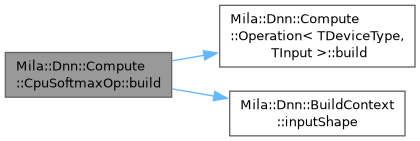
◆ build()
|
inlineoverridevirtual |
Build the operation for a concrete input shape.
This is the COLD PATH where all setup, validation, and computation happens ONCE. After build() completes, forward() and backward() become pure dispatch methods.
Responsibilities:
- Validate input shape compatibility
- Compute and cache normalized axis
- Compute and cache dimension sizes (outer, dim, inner)
- Cache OMP parallelization threshold
After build(), the operation is ready for zero-overhead forward/backward dispatch.
Reimplemented from Mila::Dnn::Compute::Operation< TDeviceType, TInput >.
◆ forward()
|
inlineoverridevirtual |
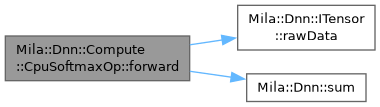
Forward pass - HOT PATH, pure dispatch to CPU kernel.
All setup, validation, and dimension computation was done in build(). This method extracts raw pointers and dispatches directly to the numerically-stable softmax kernel using pre-computed cached dimensions.
Algorithm: softmax(x) = exp(x - max(x)) / sum(exp(x - max(x))) Zero redundant work - maximum performance.
Implements Mila::Dnn::Compute::UnaryOperation< DeviceType::Cpu, TensorDataType::FP32 >.
◆ getConfig()
|
inline |
◆ getName()
|
inlineoverridevirtual |
Human-readable operation name.
Implements Mila::Dnn::Compute::Operation< TDeviceType, TInput >.
◆ getOperationType()
|
inlineoverridevirtual |
Operation type identifier.
Implements Mila::Dnn::Compute::Operation< TDeviceType, TInput >.
◆ setParameters()
|
inlineoverridevirtual |
Set parameter tensor references (no-op for Softmax - stateless operation).
Softmax has no trainable parameters, so this method validates that the inputs are null and does nothing else.
Reimplemented from Mila::Dnn::Compute::Operation< TDeviceType, TInput >.
Member Data Documentation
◆ cached_axis_
|
private |
◆ cached_dim_size_
|
private |
◆ cached_inner_size_
|
private |
◆ cached_outer_size_
|
private |
◆ config_
|
private |
◆ context_
|
private |
◆ enable_omp_
|
private |
The documentation for this class was generated from the following file:
- /__w/Mila/Mila/Mila/Src/Dnn/Compute/Devices/Cpu/Operations/CpuSoftmaxOp.ixx