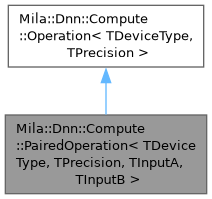
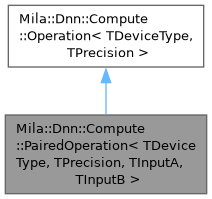
Abstract base for paired operations: two inputs -> two outputs. More...
Public Types | |
| using | MR = CpuMemoryResource |
| using | TensorInputAType = Tensor<TInputA, MR> |
| using | TensorInputBType = Tensor<TInputB, MR> |
| using | TensorOutputType = Tensor<TPrecision, MR> |
| Public Types inherited from Mila::Dnn::Compute::Operation< TDeviceType, TPrecision > | |
| using | DataTypeTraits |
Public Member Functions | |
| virtual | ~PairedOperation ()=default |
| virtual void | backward (const ITensor &grad_out_a, const ITensor &grad_out_b, ITensor &grad_in_a, ITensor &grad_in_b) const =0 |
| Backward pass: propagate upstream gradients to input gradients. | |
| virtual void | forward (const ITensor &in_a, const ITensor &in_b, ITensor &out_a, ITensor &out_b) const =0 |
| Forward pass: (out_a, out_b) = f(in_a, in_b). | |
| Public Member Functions inherited from Mila::Dnn::Compute::Operation< TDeviceType, TPrecision > | |
| virtual | ~Operation ()=default |
| virtual void | build (const BuildContext &build_context) |
| Prepare the operation for a concrete input shape. | |
| virtual void | clearGradients () noexcept |
| Clear any cached gradient pointers held by the operation. | |
| virtual TensorDataType | getDataType () const |
| Tensor data type for this operation. | |
| virtual DeviceType | getDeviceType () const |
| Device type for this operation. | |
| virtual std::string | getName () const=0 |
| Human-readable operation name. | |
| virtual OperationType | getOperationType () const=0 |
| Operation type identifier. | |
| virtual std::size_t | getStateMemorySize () const |
| Returns the number of bytes of state memory allocated by this operation. | |
| virtual bool | isBuilt () const |
| Whether build() completed successfully for a concrete input shape. | |
| virtual bool | isEvalMode () const |
| Query whether operation is configured for training. | |
| virtual void | setGradients (ITensor *weight_grad, ITensor *bias_grad) |
| Bind module-owned gradient tensors to the operation. | |
| virtual void | setParameters (ITensor *weight, ITensor *bias) |
| Bind module-owned parameter tensors to the operation. | |
| virtual void | setTrainingMode (TrainingMode training_mode) |
| Configure operation training-mode behavior. | |
Static Protected Member Functions | |
| static const TensorInputAType & | asInputA (const ITensor &t) |
| static const TensorInputBType & | asInputB (const ITensor &t) |
| static TensorOutputType & | asOutputTensor (ITensor &t) |
Additional Inherited Members | |
| Static Public Attributes inherited from Mila::Dnn::Compute::Operation< TDeviceType, TPrecision > | |
| static constexpr TensorDataType | data_type |
| static constexpr DeviceType | device_type |
| Protected Attributes inherited from Mila::Dnn::Compute::Operation< TDeviceType, TPrecision > | |
| bool | is_built_ |
| TrainingMode | training_mode_ |
Detailed Description
requires PrecisionSupportedOnDevice<TPrecision, TDeviceType>
class Mila::Dnn::Compute::PairedOperation< TDeviceType, TPrecision, TInputA, TInputB >
Abstract base for paired operations: two inputs -> two outputs.
Models symmetric transforms where two tensors are processed jointly and each produces an independent output (e.g. Q and K in RoPE).
The backward signature is symmetric with forward: 2-in / 2-out. Implementations that require saved forward activations for their backward pass must cache them internally during forward().
- Template Parameters
-
TDeviceType Device target (DeviceType::Cpu, DeviceType::Cuda, ...) TPrecision Canonical element precision for inputs and outputs (e.g. FP32) TInputA Element type for the first input tensor (defaults to TPrecision) TInputB Element type for the second input tensor (defaults to TInputA)
Member Typedef Documentation
◆ MR
| using Mila::Dnn::Compute::PairedOperation< TDeviceType, TPrecision, TInputA, TInputB >::MR = CpuMemoryResource |
◆ TensorInputAType
| using Mila::Dnn::Compute::PairedOperation< TDeviceType, TPrecision, TInputA, TInputB >::TensorInputAType = Tensor<TInputA, MR> |
◆ TensorInputBType
| using Mila::Dnn::Compute::PairedOperation< TDeviceType, TPrecision, TInputA, TInputB >::TensorInputBType = Tensor<TInputB, MR> |
◆ TensorOutputType
| using Mila::Dnn::Compute::PairedOperation< TDeviceType, TPrecision, TInputA, TInputB >::TensorOutputType = Tensor<TPrecision, MR> |
Constructor & Destructor Documentation
◆ ~PairedOperation()
|
virtualdefault |
Member Function Documentation
◆ asInputA()
|
inlinestaticprotected |
◆ asInputB()
|
inlinestaticprotected |
◆ asOutputTensor()
|
inlinestaticprotected |
◆ backward()
|
pure virtual |
Backward pass: propagate upstream gradients to input gradients.
- Parameters
-
grad_out_a Upstream gradient w.r.t. out_a (dL/dout_a). grad_out_b Upstream gradient w.r.t. out_b (dL/dout_b). grad_in_a Output gradient w.r.t. in_a (dL/din_a). grad_in_b Output gradient w.r.t. in_b (dL/din_b).
Implemented in Mila::Dnn::Compute::Cuda::Rope::CudaRopeOp< TComputePrecision >, Mila::Dnn::Compute::Cuda::Rope::CudaRopeOp< TensorDataType::BF16 >, and Mila::Dnn::Compute::Cuda::Rope::CudaRopeOp< TensorDataType::FP32 >.
◆ forward()
|
pure virtual |
Forward pass: (out_a, out_b) = f(in_a, in_b).
- Parameters
-
in_a First input tensor. in_b Second input tensor. out_a First output tensor (same shape as in_a). out_b Second output tensor (same shape as in_b).
Implemented in Mila::Dnn::Compute::Cuda::Rope::CudaRopeOp< TComputePrecision >, Mila::Dnn::Compute::Cuda::Rope::CudaRopeOp< TensorDataType::BF16 >, and Mila::Dnn::Compute::Cuda::Rope::CudaRopeOp< TensorDataType::FP32 >.
The documentation for this class was generated from the following file:
- /__w/Mila/Mila/Mila/Src/Dnn/Compute/Operations/PairedOperation.ixx