Device-templated fully connected (linear) component. More...
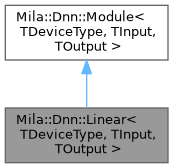
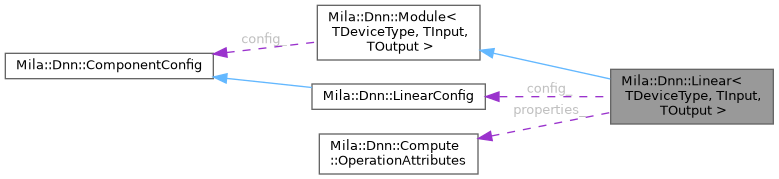
Public Types | |
| using | ComponentBase = Component<TDeviceType, TComputePrecision> |
| using | MR = typename DeviceTypeTraits<TDeviceType>::memory_resource |
| using | OpType = typename OperationTraits<OperationType::LinearOp, TDeviceType, TComputePrecision, TWeightQuant>::type |
| using | TensorType = Tensor<TComputePrecision, MR> |
| using | WeightScaleTensorType = Tensor<TWeightQuant::kScaleDtype, MR> |
| using | WeightTensorType = Tensor<kWeightDtype, MR> |
Public Member Functions | |
| Linear (const std::string &name, const LinearConfig &config, std::optional< DeviceId > device_id=std::nullopt) | |
| Construct a Linear component. | |
| ~Linear () override=default | |
| TensorType & | backward (const TensorType &input, const TensorType &output_grad) |
| Perform backward pass. | |
| TensorType & | forward (const TensorType &input) |
| Perform forward pass: output = input * weight^T + bias. | |
| const LinearConfig & | getConfig () const noexcept |
| DeviceId | getDeviceId () const override |
| Get the compute device id associated with this component. | |
| std::vector< ITensor * > | getGradients () const override |
| Return non-owning pointers to parameter gradient tensors. | |
| MemoryStats | getMemoryStats () const override |
| Return the current memory allocation breakdown for this component. | |
| std::vector< ITensor * > | getParameters () const override |
| Return non-owning pointers to parameter tensors. | |
| const ComponentType | getType () const override |
| Get the component type identifier. | |
| bool | hasBias () const noexcept |
| void | loadParameter (const std::string &name, const ITensorBlob &blob) override |
| Load a named parameter from a serialized blob. | |
| size_t | parameterCount () const override |
| Return number of trainable parameters. | |
| void | save_ (ModelArchive &archive, SerializationMode mode) const override |
| Save component state to a ModelArchive. | |
| void | synchronize () override |
| Wait for outstanding device work submitted by this component. | |
| std::string | toString () const override |
| Produce a short, human-readable description of the component. | |
| void | zeroGradients () override |
| Clear all model-owned gradients for this component. | |
| Public Member Functions inherited from Mila::Dnn::Component< TDeviceType, TComputePrecision > | |
| Component (const std::string &name) | |
| Construct component with required name identifier. | |
| virtual | ~Component ()=default |
| virtual void | build (const BuildContext &context) final |
| Build the component with the provided BuildContext (canonical overload). | |
| const std::string | getName () const |
| Get the component's name identifier. | |
| virtual std::vector< std::string > | getParameterNames () const |
| List all available parameter names for this component. | |
| RuntimeMode | getRuntimeMode () const noexcept |
| Convenience accessor — true if currently in Eval mode. | |
| TrainingMode | getTrainingMode () const noexcept |
| The current runtime behavioral mode of this Component. | |
| virtual bool | isBuilt () const final |
| Returns true if build() has completed successfully. | |
| bool | isInferenceMode () const noexcept |
| bool | isTrainingMode () const noexcept |
| void | setTrainingMode (TrainingMode mode) |
| Set the runtime behavioral mode for this Component. | |
Static Public Attributes | |
| static constexpr bool | kIsQuantized = TWeightQuant::kIsQuantized |
| static constexpr TensorDataType | kWeightDtype |
Protected Member Functions | |
| void | onBuilding (const BuildContext &context) override |
| Hook invoked by build() to allocate component buffers. | |
| void | onExecutionContextSet () override |
| Lifecycle hook: Called immediately after ExecutionContext is set. | |
| void | onTrainingModeChanging (TrainingMode mode) override |
| Hook called before TrainingMode transitions. | |
| Protected Member Functions inherited from Mila::Dnn::Component< TDeviceType, TComputePrecision > | |
| IExecutionContext * | getExecutionContext () const |
| Get the shared execution context. | |
| bool | hasExecutionContext () const noexcept |
| Check if execution context has been set. | |
| void | loadParameterFromBlob (const std::string ¶m_name, const Serialization::ITensorBlob &blob, Tensor< TParameterPrecision, TMemoryResource > &target, const shape_t &expected_shape) |
| Load a tensor blob into a parameter tensor with validation. | |
| void | setExecutionContext (IExecutionContext *context) |
| Set the execution context for this component. | |
Private Member Functions | |
| void | createOperation () |
| Instantiate the backend compute operation via compile-time traits dispatch. | |
| void | initializeGradients () |
| void | initializeParameters (const BuildContext &context) |
| void | validateBuildContext (const BuildContext &context) const |
| void | validateInputShape (const shape_t &input_shape) const |
Private Attributes | |
| std::shared_ptr< TensorType > | bias_ { nullptr } |
| std::shared_ptr< TensorType > | bias_grad_ { nullptr } |
| LinearConfig | config_ |
| std::unique_ptr< TensorType > | input_grad_ { nullptr } |
| shape_t | leading_shape_ |
| std::shared_ptr< OpType > | operation_ { nullptr } |
| std::unique_ptr< TensorType > | output_ { nullptr } |
| std::unique_ptr< TensorType > | output_view_ { nullptr } |
| std::unique_ptr< IExecutionContext > | owned_exec_context_ { nullptr } |
| std::shared_ptr< WeightTensorType > | weight_ { nullptr } |
| std::shared_ptr< TensorType > | weight_grad_ { nullptr } |
| std::unique_ptr< WeightScaleTensorType > | weight_scales_ { nullptr } |
Additional Inherited Members | |
| Static Public Member Functions inherited from Mila::Dnn::Component< TDeviceType, TComputePrecision > | |
| static constexpr DeviceType | getDeviceType () |
| Compile-time device type for this component instance. | |
| static constexpr TensorDataType | getPrecision () noexcept |
| Compile-time tensor precision for this component instance. | |
| Protected Attributes inherited from Mila::Dnn::Component< TDeviceType, TComputePrecision > | |
| BuildContext | build_context_ |
| The BuildContext stored at build time. | |
Detailed Description
requires PrecisionSupportedOnDevice<TComputePrecision, TDeviceType>
class Mila::Dnn::Linear< TDeviceType, TComputePrecision, TWeightQuant >
Device-templated fully connected (linear) component.
Delegates compute to a device-specific operation resolved at compile time via OperationTraits<LinearOp, TDeviceType, TComputePrecision, TWeightQuant>. TWeightQuant defaults to NoWeightQuant for unquantized paths.
When TWeightQuant::kIsQuantized is true, the weight tensor is allocated at the reduced-precision storage dtype (kWeightDtype = TWeightQuant::kStorageDtype) rather than TComputePrecision. Per-channel FP32 scale factors (weight_scales_) are allocated alongside the weight tensor and bound to the backend operation via setWeightScales() before the first forward pass. The backend operation receives both the quantized weight tensor and its scales and is responsible for dequantization during the GEMM.
Weight quantization is performed once at model load time (quantize-on-load) during loadParameter(). The source checkpoint blob is always at TComputePrecision.
- Template Parameters
-
TDeviceType Target device. TComputePrecision Activation and accumulation precision. TWeightQuant Weight quantization policy. Must satisfy WeightQuantPolicy. Defaults to NoWeightQuant (identity — no quantization).
Constructor & Destructor Documentation
◆ Linear()
|
inlineexplicitexport |
Construct a Linear component.
Constructs with a name and configuration. If device_id is provided, the component creates and owns an ExecutionContext (standalone mode) and registers it with the base Component via setExecutionContext(). If device_id is not provided, the component expects a shared ExecutionContext to be provided later via setExecutionContext().
- Parameters
-
name Component name. config Layer configuration (validated on construction). device_id Optional device identifier. When present the component creates an owned ExecutionContext for the device.
- Exceptions
-
std::invalid_argument if config is invalid or device type mismatches. std::runtime_error if ExecutionContext creation fails.
◆ ~Linear()
|
overrideexportdefault |
Member Function Documentation
◆ backward()
|
inlineexport |
Perform backward pass.
Pre-zeros the component-owned input gradient buffer, then delegates to the backend operation. The backend accumulates weight and bias gradients into the buffers bound via setGradients() using += semantics; pre-zeroing ensures clean gradient state across calls.
Not supported on quantized paths (kIsQuantized == true) — the backend operation will throw std::logic_error if backward is attempted.
- Parameters
-
input Original forward-pass input tensor. output_grad Upstream gradient tensor (same shape as the forward output).
- Returns
- Reference to the component-owned input gradient tensor.
- Exceptions
-
std::runtime_error if the component has not been built. std::runtime_error if called while in inference (eval) mode.
◆ createOperation()
|
inlineexportprivate |
Instantiate the backend compute operation via compile-time traits dispatch.
OpType is resolved by OperationTraits at instantiation time — no registry lookup, no string key, no runtime hash map. A missing specialization is a compile error.
◆ forward()
|
inlineexport |
Perform forward pass: output = input * weight^T + bias.
Delegates to the backend operation using the component-owned output buffer allocated at build time. When the runtime input shape differs from the build-time shape (e.g. a shorter decode sequence vs. the prefill shape), a lightweight view over the output buffer is returned that reflects the true output shape without reallocating device memory.
- Parameters
-
input Input tensor (device-bound, rank >= 2). The last dimension must equal the configured input feature count.
- Returns
- Reference to the output tensor or a shape-adjusted view of it.
- Exceptions
-
std::runtime_error if the component has not been built. std::invalid_argument if the input feature dimension does not match the config.
◆ getConfig()
|
inlineexportnoexcept |
◆ getDeviceId()
|
inlineoverrideexportvirtual |
Get the compute device id associated with this component.
Must return the device on which parameters and operations execute.
Implements Mila::Dnn::Component< TDeviceType, TComputePrecision >.
◆ getGradients()
|
inlineoverrideexportvirtual |
Return non-owning pointers to parameter gradient tensors.
Only valid when isTraining() is true.
- Exceptions
-
std::runtime_error if called when not in training mode or before the component has been built.
Implements Mila::Dnn::Component< TDeviceType, TComputePrecision >.
◆ getMemoryStats()
|
inlineoverrideexportvirtual |
Return the current memory allocation breakdown for this component.
Reflects allocations at the moment of the call. The returned stats naturally track the component lifecycle:
After construction — parameters only After build( Inference ) — parameters + T=1 state buffers After build( Training ) — parameters + T=full state buffers After setEvaluation( false ) — parameters + state + gradients
For CompositeComponent and Network, the returned stats are the recursive aggregate of all child components.
May be called at any time — no lifecycle preconditions.
- Returns
- MemoryStats reflecting current allocations.
Implements Mila::Dnn::Component< TDeviceType, TComputePrecision >.
◆ getParameters()
|
inlineoverrideexportvirtual |
Return non-owning pointers to parameter tensors.
The returned tensor pointers remain valid for the lifetime of the component. Order should be canonical (weights before biases).
Implements Mila::Dnn::Component< TDeviceType, TComputePrecision >.
◆ getType()
|
inlineoverrideexportvirtual |
Get the component type identifier.
Used for serialization and runtime type identification.
- Returns
- Component type enum value.
Implements Mila::Dnn::Component< TDeviceType, TComputePrecision >.
◆ hasBias()
|
inlineexportnoexcept |
◆ initializeGradients()
|
inlineexportprivate |
◆ initializeParameters()
|
inlineexportprivate |
◆ loadParameter()
|
inlineoverrideexportvirtual |
Load a named parameter from a serialized blob.
Weight loading dispatches at compile time on kIsQuantized:
- Unquantized path (kIsQuantized == false): the blob is validated against TComputePrecision and copied directly into the weight tensor via loadParameterFromBlob.
- Quantized path (kIsQuantized == true): the blob dtype must be TComputePrecision (the full-precision source type). The backend operation's quantize() method performs per-channel absmax scale computation, quantizes weights from TComputePrecision to kWeightDtype (e.g. BF16 → FP8_E4M3), and uploads both the quantized weights and FP32 scales to device. The weight_scales_ tensor was pre-allocated in initializeParameters() and its device pointer was already bound to the operation in onBuilding() via setWeightScales() — quantize() writes directly into that allocation.
Bias is always stored and loaded at TComputePrecision regardless of TWeightQuant.
- Parameters
-
name Parameter name: "weight" or "bias". blob Serialized tensor blob from PretrainedModelReader.
- Exceptions
-
std::invalid_argument if the blob dtype does not match the expected source precision, or if the blob shape does not match the config.
Reimplemented from Mila::Dnn::Component< TDeviceType, TComputePrecision >.
◆ onBuilding()
|
inlineoverrideexportprotectedvirtual |
Hook invoked by build() to allocate component buffers.
Receives the stored BuildContext. Implementations must use config.allocationSeqLen() when sizing output buffers — this is the single call that makes Inference and Training allocate the correct buffer sizes automatically without per-component logic.
The default implementation forwards to the legacy onBuilding( const shape_t& ) overload for backwards compatibility. New components should override this overload directly.
- Note
- Do not call build() or onBuilding() from within this hook.
- Implementations should either succeed fully or leave no partial state, as a failed build() may be retried.
- Parameters
-
config Build-time configuration. Use config.allocationSeqLen() to obtain the correct output buffer sequence dimension.
Reimplemented from Mila::Dnn::Component< TDeviceType, TComputePrecision >.
◆ onExecutionContextSet()
|
inlineoverrideexportprotectedvirtual |
Lifecycle hook: Called immediately after ExecutionContext is set.
Override this to perform initialization that requires a valid ExecutionContext. At the time this is called, getExecutionContext() is guaranteed to return a valid context.
Common uses:
- Composite components: Create and configure child components.
- Device resource allocation: Query device capabilities.
Default implementation does nothing.
- Exceptions
-
Any exception thrown will cause setExecutionContext() to fail and restore the component to a "context not set" state.
Reimplemented from Mila::Dnn::Component< TDeviceType, TComputePrecision >.
◆ onTrainingModeChanging()
|
inlineoverrideexportprotectedvirtual |
Hook called before TrainingMode transitions.
Called by setTrainingMode() after validation and lock acquisition, before the internal state is updated. Derived classes override to respond to the transition — e.g. zeroing gradient buffers on transition to Eval, or re-enabling dropout on transition to Training.
The default implementation is a no-op.
- Parameters
-
mode The incoming TrainingMode.
Reimplemented from Mila::Dnn::Component< TDeviceType, TComputePrecision >.
◆ parameterCount()
|
inlineoverrideexportvirtual |
Return number of trainable parameters.
For leaf components this is the element count of owned parameter tensors. CompositeComponent and Network implementations should return the recursive aggregate across all children.
Implements Mila::Dnn::Component< TDeviceType, TComputePrecision >.
◆ save_()
|
inlineoverrideexportvirtual |
Save component state to a ModelArchive.
Writes a "meta.json" blob with component type and name, a "config.json" blob with input/output feature dimensions and bias flag, and raw tensor blobs for the weight and (if present) bias parameters under "tensors/".
On CUDA devices, each tensor is copied to a temporary host buffer before writing. Weight is serialized at its storage dtype (kWeightDtype), which equals kWeightDtype = TWeightQuant::kStorageDtype on the quantized path.
- Parameters
-
archive ModelArchive to write to (scoped by caller). mode Serialization mode (currently unused; reserved for future use).
Implements Mila::Dnn::Component< TDeviceType, TComputePrecision >.
◆ synchronize()
|
inlineoverrideexportvirtual |
Wait for outstanding device work submitted by this component.
On CPU this may be a no-op. Use to ensure results are visible to the host or to measure synchronous timings.
Implements Mila::Dnn::Component< TDeviceType, TComputePrecision >.
◆ toString()
|
inlineoverrideexportvirtual |
Produce a short, human-readable description of the component.
Implementations should keep output concise and avoid throwing.
Implements Mila::Dnn::Component< TDeviceType, TComputePrecision >.
◆ validateBuildContext()
|
inlineexportprivate |
◆ validateInputShape()
|
inlineexportprivate |
◆ zeroGradients()
|
inlineoverrideexportvirtual |
Clear all model-owned gradients for this component.
Default implementation is a no-op. Composite components should override to recurse to children. Leaf components should override to zero their parameter and activation gradients using device-aware helpers.
Reimplemented from Mila::Dnn::Component< TDeviceType, TComputePrecision >.
The documentation for this class was generated from the following file:
- /__w/Mila/Mila/Mila/Src/Dnn/Components/Linear/Linear.ixx