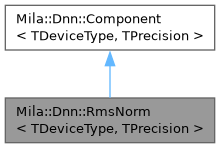
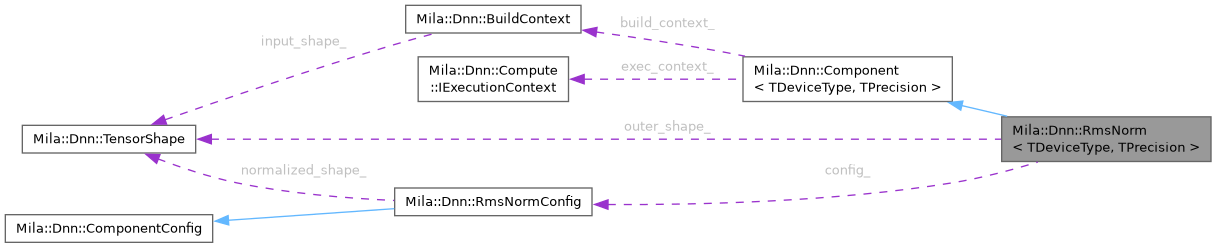
Device-templated RMS Normalization component. More...
Public Types | |
| using | ComponentBase = Component<TDeviceType, TPrecision> |
| using | MR = typename DeviceTypeTraits<TDeviceType>::memory_resource |
| using | TensorType = Tensor<TPrecision, MR> |
Public Member Functions | |
| RmsNorm (const std::string &name, const RmsNormConfig &config, std::optional< DeviceId > device_id=std::nullopt) | |
| ~RmsNorm () override=default | |
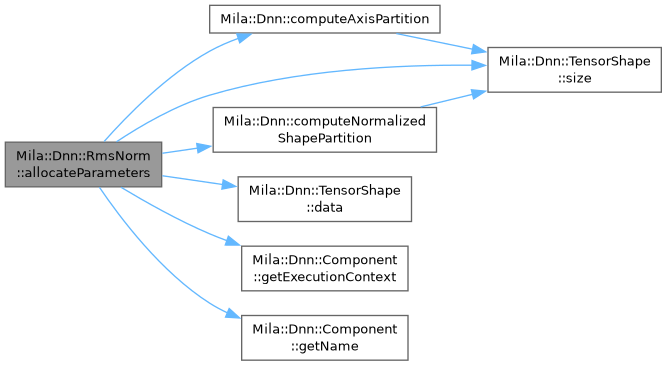
| TensorType & | backward (const TensorType &input, const TensorType &output_grad) |
| Run backward pass and return a reference to the component-owned input-gradient tensor. | |
| TensorType & | forward (const TensorType &input) |
| Run forward pass and return a reference to the component-owned output tensor. | |
| DeviceId | getDeviceId () const override |
| Get the compute device id associated with this component. | |
| std::vector< ITensor * > | getGradients () const override |
| Return non-owning pointers to parameter gradient tensors. | |
| MemoryStats | getMemoryStats () const override |
| Return the current memory allocation breakdown for this component. | |
| std::vector< ITensor * > | getParameters () const override |
| Return non-owning pointers to parameter tensors. | |
| const ComponentType | getType () const override |
| Get the component type identifier. | |
| void | loadParameter (const std::string &name, const ITensorBlob &blob) override |
| Load a parameter from serialized tensor data. | |
| size_t | parameterCount () const override |
| Return number of trainable parameters. | |
| void | save_ (ModelArchive &archive, SerializationMode mode) const override |
| void | synchronize () override |
| Wait for outstanding device work submitted by this component. | |
| std::string | toString () const override |
| Produce a short, human-readable description of the component. | |
| void | zeroGradients () override |
| Clear all model-owned gradients for this component. | |
| Public Member Functions inherited from Mila::Dnn::Component< TDeviceType, TPrecision > | |
| Component (const std::string &name) | |
| Construct component with required name identifier. | |
| virtual | ~Component ()=default |
| virtual void | build (const BuildContext &context) final |
| Build the component with the provided BuildContext (canonical overload). | |
| const std::string | getName () const |
| Get the component's name identifier. | |
| virtual std::vector< std::string > | getParameterNames () const |
| List all available parameter names for this component. | |
| RuntimeMode | getRuntimeMode () const noexcept |
| Convenience accessor — true if currently in Eval mode. | |
| TrainingMode | getTrainingMode () const noexcept |
| The current runtime behavioral mode of this Component. | |
| virtual bool | isBuilt () const final |
| Returns true if build() has completed successfully. | |
| bool | isInferenceMode () const noexcept |
| bool | isTrainingMode () const noexcept |
| void | setTrainingMode (TrainingMode mode) |
| Set the runtime behavioral mode for this Component. | |
Protected Member Functions | |
| void | onBuilding (const BuildContext &build_context) override |
| Hook invoked by build() to allocate component buffers. | |
| void | onExecutionContextSet () override |
| Lifecycle hook: Called immediately after ExecutionContext is set. | |
| void | onTrainingModeChanging (TrainingMode training_mode) override |
| Hook called before TrainingMode transitions. | |
| Protected Member Functions inherited from Mila::Dnn::Component< TDeviceType, TPrecision > | |
| IExecutionContext * | getExecutionContext () const |
| Get the shared execution context. | |
| bool | hasExecutionContext () const noexcept |
| Check if execution context has been set. | |
| template<TensorDataType TParameterPrecision, typename TMemoryResource> | |
| void | loadParameterFromBlob (const std::string ¶m_name, const Serialization::ITensorBlob &blob, Tensor< TParameterPrecision, TMemoryResource > &target, const shape_t &expected_shape) |
| Load a tensor blob into a parameter tensor with validation. | |
| void | setExecutionContext (IExecutionContext *context) |
| Set the execution context for this component. | |
Private Types | |
| using | OpType = typename OperationTraits<OperationType::RmsNormOp, TDeviceType, TPrecision>::type |
Private Member Functions | |
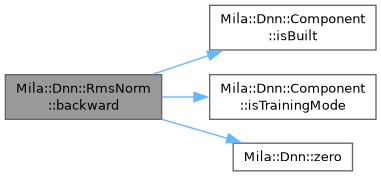
| void | allocateParameters (const shape_t *input_shape) |
| void | createOperation () |
| void | initializeGradients () |
| void | validateInputShape (const shape_t &input_shape) const |
Private Attributes | |
| std::shared_ptr< TensorType > | bias_ { nullptr } |
| std::shared_ptr< TensorType > | bias_grad_ { nullptr } |
| RmsNormConfig | config_ |
| std::unique_ptr< TensorType > | input_grad_ { nullptr } |
| std::shared_ptr< OpType > | operation_ { nullptr } |
| shape_t | outer_shape_ |
| std::unique_ptr< TensorType > | output_ { nullptr } |
| std::optional< TensorType > | output_view_ |
| std::unique_ptr< IExecutionContext > | owned_exec_context_ { nullptr } |
| std::shared_ptr< TensorType > | weight_ { nullptr } |
| std::shared_ptr< TensorType > | weight_grad_ { nullptr } |
Additional Inherited Members | |
| Static Public Member Functions inherited from Mila::Dnn::Component< TDeviceType, TPrecision > | |
| static constexpr DeviceType | getDeviceType () |
| Compile-time device type for this component instance. | |
| static constexpr TensorDataType | getPrecision () noexcept |
| Compile-time tensor precision for this component instance. | |
| Protected Attributes inherited from Mila::Dnn::Component< TDeviceType, TPrecision > | |
| BuildContext | build_context_ { shape_t{ 1 }, RuntimeMode::Training } |
| The BuildContext stored at build time. | |
Detailed Description
requires PrecisionSupportedOnDevice<TPrecision, TDeviceType>
class Mila::Dnn::RmsNorm< TDeviceType, TPrecision >
Device-templated RMS Normalization component.
Delegates heavy compute to a UnaryOperation backend (registered as "RmsNormOp"). Parameters (weight/bias) and parameter gradients are owned by the component.
Constructor & Destructor Documentation
◆ RmsNorm()
|
inlineexplicitexport |

◆ ~RmsNorm()
|
overrideexportdefault |
Member Function Documentation
◆ allocateParameters()
|
inlineexportprivate |

◆ backward()
|
inlineexport |
Run backward pass and return a reference to the component-owned input-gradient tensor.
- Parameters
-
input Original forward input tensor. output_grad Gradient with respect to the component output.
- Returns
- Reference to the component-owned input-gradient tensor.
◆ createOperation()
|
inlineexportprivate |


◆ forward()
|
inlineexport |
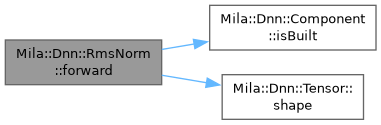
Run forward pass and return a reference to the component-owned output tensor.
Dispatches to the operation via a cached output view. The view is pre-initialized at build time and rebuilt only when the input shape changes (e.g. prefill vs decode). Zero heap allocation in steady-state.
- Parameters
-
input Input tensor bound to the component device.
- Returns
- Reference to the cached output view.
◆ getDeviceId()
|
inlineoverrideexportvirtual |
Get the compute device id associated with this component.
Must return the device on which parameters and operations execute.
Implements Mila::Dnn::Component< TDeviceType, TPrecision >.

◆ getGradients()
|
inlineoverrideexportvirtual |
Return non-owning pointers to parameter gradient tensors.
Only valid when isTraining() is true.
- Exceptions
-
std::runtime_error if called when not in training mode or before the component has been built.
Implements Mila::Dnn::Component< TDeviceType, TPrecision >.
◆ getMemoryStats()
|
inlineoverrideexportvirtual |
Return the current memory allocation breakdown for this component.
Reflects allocations at the moment of the call. The returned stats naturally track the component lifecycle:
After construction — parameters only After build( Inference ) — parameters + T=1 state buffers After build( Training ) — parameters + T=full state buffers After setEvaluation( false ) — parameters + state + gradients
For CompositeComponent and Network, the returned stats are the recursive aggregate of all child components.
May be called at any time — no lifecycle preconditions.
- Returns
- MemoryStats reflecting current allocations.
Implements Mila::Dnn::Component< TDeviceType, TPrecision >.
◆ getParameters()
|
inlineoverrideexportvirtual |
Return non-owning pointers to parameter tensors.
The returned tensor pointers remain valid for the lifetime of the component. Order should be canonical (weights before biases).
Implements Mila::Dnn::Component< TDeviceType, TPrecision >.
◆ getType()
|
inlineoverrideexportvirtual |
Get the component type identifier.
Used for serialization and runtime type identification.
- Returns
- Component type enum value.
Implements Mila::Dnn::Component< TDeviceType, TPrecision >.
◆ initializeGradients()
|
inlineexportprivate |


◆ loadParameter()
|
inlineoverrideexportvirtual |
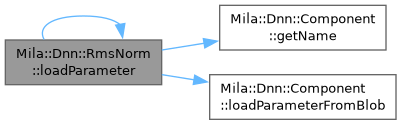
Load a parameter from serialized tensor data.
Loads raw tensor bytes directly into an existing parameter tensor, handling precision conversion and device upload as needed.
The component validates that the blob's shape matches the parameter's expected shape, then delegates to the backend to perform:
- Precision conversion (blob dtype → parameter dtype)
- Device upload (CPU bytes → target device)
- Parameters
-
name Parameter name used to locate the target tensor. blob Serialized tensor metadata and raw bytes.
- Exceptions
-
std::runtime_error if component has no parameters to load. std::runtime_error if blob shape doesn't match parameter shape.
Reimplemented from Mila::Dnn::Component< TDeviceType, TPrecision >.
◆ onBuilding()
|
inlineoverrideexportprotectedvirtual |
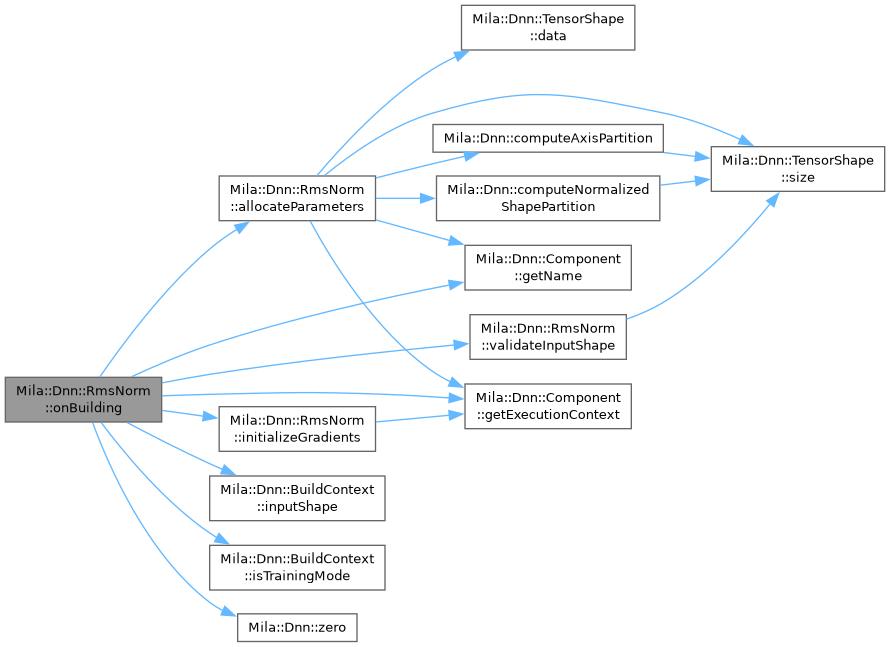
Hook invoked by build() to allocate component buffers.
Receives the stored BuildContext. Implementations must use config.allocationSeqLen() when sizing output buffers — this is the single call that makes Inference and Training allocate the correct buffer sizes automatically without per-component logic.
The default implementation forwards to the legacy onBuilding( const shape_t& ) overload for backwards compatibility. New components should override this overload directly.
- Note
- Do not call build() or onBuilding() from within this hook.
- Implementations should either succeed fully or leave no partial state, as a failed build() may be retried.
- Parameters
-
config Build-time configuration. Use config.allocationSeqLen() to obtain the correct output buffer sequence dimension.
Reimplemented from Mila::Dnn::Component< TDeviceType, TPrecision >.
◆ onExecutionContextSet()
|
inlineoverrideexportprotectedvirtual |
Lifecycle hook: Called immediately after ExecutionContext is set.
Override this to perform initialization that requires a valid ExecutionContext. At the time this is called, getExecutionContext() is guaranteed to return a valid context.
Common uses:
- Composite components: Create and configure child components.
- Device resource allocation: Query device capabilities.
Default implementation does nothing.
- Exceptions
-
Any exception thrown will cause setExecutionContext() to fail and restore the component to a "context not set" state.
Reimplemented from Mila::Dnn::Component< TDeviceType, TPrecision >.

◆ onTrainingModeChanging()
|
inlineoverrideexportprotectedvirtual |
Hook called before TrainingMode transitions.
Called by setTrainingMode() after validation and lock acquisition, before the internal state is updated. Derived classes override to respond to the transition — e.g. zeroing gradient buffers on transition to Eval, or re-enabling dropout on transition to Training.
The default implementation is a no-op.
- Parameters
-
mode The incoming TrainingMode.
Reimplemented from Mila::Dnn::Component< TDeviceType, TPrecision >.
◆ parameterCount()
|
inlineoverrideexportvirtual |
Return number of trainable parameters.
For leaf components this is the element count of owned parameter tensors. CompositeComponent and Network implementations should return the recursive aggregate across all children.
Implements Mila::Dnn::Component< TDeviceType, TPrecision >.

◆ save_()
|
inlineoverrideexportvirtual |
Implements Mila::Dnn::Component< TDeviceType, TPrecision >.
◆ synchronize()
|
inlineoverrideexportvirtual |
Wait for outstanding device work submitted by this component.
On CPU this may be a no-op. Use to ensure results are visible to the host or to measure synchronous timings.
Implements Mila::Dnn::Component< TDeviceType, TPrecision >.

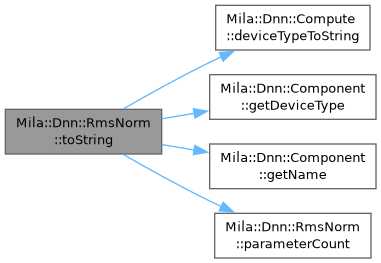
◆ toString()
|
inlineoverrideexportvirtual |
Produce a short, human-readable description of the component.
Implementations should keep output concise and avoid throwing.
Implements Mila::Dnn::Component< TDeviceType, TPrecision >.
◆ validateInputShape()
|
inlineexportprivate |


◆ zeroGradients()
|
inlineoverrideexportvirtual |
Clear all model-owned gradients for this component.
Default implementation is a no-op. Composite components should override to recurse to children. Leaf components should override to zero their parameter and activation gradients using device-aware helpers.
Reimplemented from Mila::Dnn::Component< TDeviceType, TPrecision >.

The documentation for this class was generated from the following file:
- /__w/Mila/Mila/Mila/Src/Dnn/Components/Normalization/RmsNorm/RmsNorm.ixx